
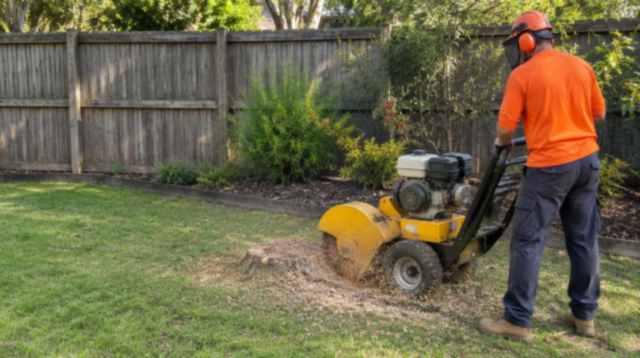
Before stump grinding starts in Sydney
Underground services need finding first. Safe Work Australia's tree work guide says to check around a stump before grinding, and to contact Before You Dig Australia (BYDA) if grinding will go deeper than 200mm or services are a concern. Privately installed lines, like irrigation or power to a shed, won't be on BYDA plans, so tell the arborist where yours run.
Stump grinding in Sydney: what's local
Sandstone country
Across much of the north and south, Sydney red gums grow on sandy soil over sandstone. Rock close to the surface can stop a grinder short of the depth you wanted, so ask what the arborist can reach on your block.
Shale and clay
Cumberland Plain Woodland in the west grows on heavy clay from Wianamatta Shale, and the northern shale forests on richer shale soils. Clay drains slowly, and on any soil the filled hole sinks as the grindings break down, so plan to top it up.
Sewers and pipes
Before it will treat roots in pipes as a reason for tree work, City of Parramatta asks for a sewer diagram and a plumber's report. If roots were the problem, grinding the stump is only half the fix: the pipe may still need a plumber.
Roots count as tree work
Cumberland needs consent to prune live roots over 30mm, Lane Cove's permit rule covers roots 40mm or more, and Ku-ring-gai counts severing roots of 50mm or more as injuring a tree. Chasing roots towards a tree you're keeping is a council question.
How stump grinding works in Sydney
Trip hazards and mower damage are the obvious reasons. Less obvious: Gardening Australia says fungi often grow on a stump, a big root system can feed them for decades, and removing the stump helps protect the living woody plants around it.
Some eucalypts also shoot again from a stump cut low, using energy stored underground. Grinding below ground level makes regrowth less likely, and an arborist can tell you whether your species is one to watch.
Questions to ask about stump grinding in Sydney
- How deep the grind goes, written as a number, and what happens if the grinder hits rock
- Whether surface roots are ground out too, and how far from the stump
- Who lodges the BYDA enquiry, and how private pipes and cables will be found
- What happens to the grindings: left in the hole, spread as mulch or taken away
- How the grinder gets in: narrow side paths, steps and gates on terrace and hillside blocks
- Whether any root work touches a tree your council protects
Stump grinding in Sydney: what you can do yourself
You can
- Mark where you know pipes, irrigation and garden lighting run
- Clear pots, rocks and toys from around the stump before the day
- Top up the hole with soil as the grindings settle
Leave to an arborist
- Running the grinder: Safe Work Australia lists ejected material, contact with the wheel and live underground services among its hazards
- Cutting roots near a tree you're keeping, or a neighbour's tree
- Deciding how deep is safe near pipes, paths and footings

Hiring an arborist for stump grinding in Sydney
Find the sewer line before booking: a sewer diagram shows where it runs, and that tells you how deep is sensible. Then get a written quote that names the depth, the root work and where the grindings go. If the stump sits on sandstone or near a tree you're keeping, ask the arborist to explain how they'll handle it before you say yes.