
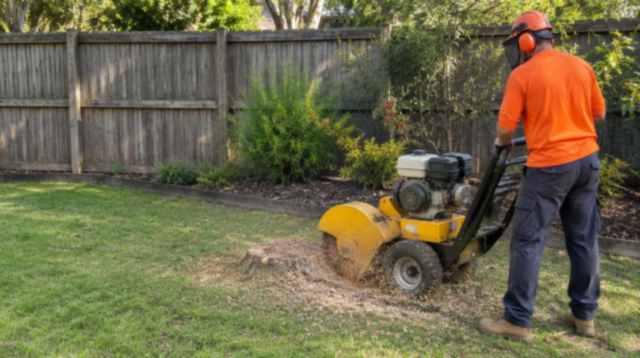
Find the pipes and cables first
A stump grinder can hit what's buried, and contact with live underground services is one of the hazards Safe Work Australia lists. Its tree work guide says to check for services around a stump before grinding, and to contact Before You Dig Australia (BYDA) if the grind will go deeper than 200mm or services are a concern. Anything you or a previous owner put in yourselves, such as irrigation or a cable out to the shed, won't show up on BYDA plans at all.
Grind it, dig it out or leave it?
| Grind | Dig out | Leave it | |
|---|---|---|---|
| What happens | A cutting wheel grinds the stump and surface roots down below ground level | The stump and its main roots are dug or pulled out | The stump is cut low and left to break down |
| What's left | A shallow hole of woodchips and soil | A large hole and a lot of disturbed soil | A stump that can reshoot, rot or grow fungi |
| Suits | Most garden stumps, lawns and replanting nearby | Small stumps, or where a slab or pool is going in | Stumps hidden in a garden bed, or too close to something to grind |
| Watch for | Buried services, and stones or metal that get thrown | Buried services, and damage to paths and nearby roots | Regrowth from species that resprout, and a trip hazard |
How deep does a stump grinder go?
There's no standard depth for private jobs, so get it written into the quote. For a reference point, Mitchell Shire Council in Victoria has its own stumps ground to at least 30 cm below natural ground level, with the surface roots grubbed out.
Deeper isn't automatically better, because the further down the grinder goes, the more likely it meets pipes and cables. If you're turfing, paving or planting there, say so: it changes how deep is worth going.
Roots are a separate question. Grinding takes out the stump and the roots close to it, while roots further out usually stay in the ground and slowly rot. If they're lifting a path, ask, and see tree root removal.
Will the stump grow back?
It depends on the tree. Some eucalypts reshoot after being cut low, because underground storage sends up new shoots, as Gardening Australia shows with a mallee. Weeds Australia says tree-of-heaven has been reported suckering from its roots for at least 4 years after the tree is cut down, sometimes many metres away.
So tell the arborist what the tree was, and ask whether it needs any follow-up.
Leaving a stump to rot has its own catch: it feeds fungi. Gardening Australia notes that a large tree's roots can keep fungi going for decades, and that taking the stump out cuts the fuel they'd otherwise use against the living woody plants in your garden.
What happens to the woodchips and the hole?
Grinding turns a stump into a heap of woodchips and soil, and a big stump makes a surprising amount. Leave them in the hole, spread them on garden beds or have them carted away, and say which in the quote.
Woodchips break down, so a hole filled with them slowly sinks. If you're turfing or paving over the spot, have the chips raked out and the hole filled with soil, and expect to top it up.
Can you replant? Yes, though it's easier a little to one side of the old stump, away from the remaining roots, or once the grindings are cleared and the hole refilled with good soil. If the old tree cracked a pipe or a path, pick something smaller: see tree roots and your house.
Does council need to know about stump grinding?
If the tree is still standing, the permit question comes first, before anyone talks about the stump.
Root work is the part that catches people. In the ACT, groundwork in a protected tree's protection zone needs approval, and the Urban Forest Act counts cutting or ripping a protected tree's roots as damaging it. If the stump sits close to a tree you're keeping, or to the neighbour's, ask the council before the grinder comes. See tree protection zones.
What a stump grinding quote should cover
- The grinding depth, as a number in centimetres or millimetres
- Whether surface roots are ground as well, and how far out from the stump
- Who will lodge the BYDA enquiry, you or the arborist
- Where the woodchips end up: left in the hole, spread on the garden or taken away
- How the machine gets to the stump: gate widths, steps, slopes and soft lawn
- How windows, cars and paths will be protected from flying debris
- What happens if the grinder hits rock, concrete or an old footing
Stump grinding: what you can do yourself
You can
- Lodge a BYDA enquiry yourself, on byda.com.au or the BYDA app, and asset owners are encouraged to reply within 2 business days
- Mark where irrigation, garden lights and any cables to sheds or pumps run
- Clear rocks, pots, toys and garden edging away from the stump
- Keep kids and pets inside while the grinder is running
- Top up the hole with soil as it settles
Leave to an arborist
- Running the grinder: Safe Work Australia lists roll-over, contact with the wheel, ejected material, noise and dust among its hazards
- Grinding close to pipes, paths, footings or a tree you're keeping
- Finding private services, with a skilled locator if needed

Hiring an arborist for stump grinding
Grind it unless there's a reason not to, and lodge the BYDA enquiry the day you decide. Then get the depth, the root work and the woodchip plan written into the quote. If the tree was a type that reshoots, or the stump sits near a tree you're keeping, raise it before the grinder turns up, not after.