
Which trees can be moved?
Palms are the usual candidates. Hume City Council's tree protection procedures treat palms as fibrous rooted, with a protection zone of the crown plus at least 1 metre. A compact root ball is what makes a move practical.
Young trees that haven't spread far can often be lifted with enough root to settle in again.
Large, established trees are the hard case. Hume describes the structural root zone as the roots and soil a tree needs to stay upright, with a larger area again to stay alive, and digging a tree out cuts through both. The City of Sydney adds that many eucalypts don't tolerate root interference well, so a big gum is a long shot.
How does an arborist move a tree?
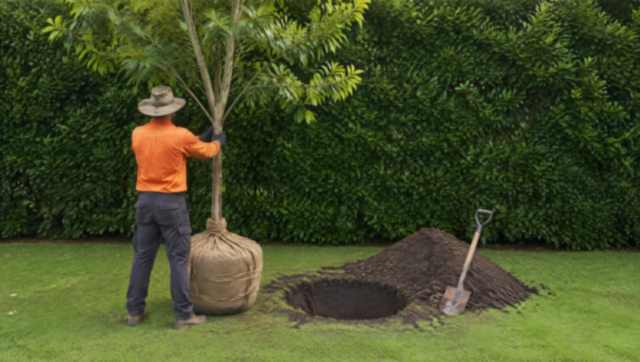
They assess the tree and the new spot first: species, size, health, access, and what's underground at both ends. On the day, the root ball is dug, wrapped and lifted, by crane or machine for anything heavy, then set at the right depth in the new hole. A Canary Island date palm's trunk can be at least 1 metre across, so lifting gear isn't optional.
Aftercare matters as much as the lift: steady watering, and leaving the soil around the new root ball alone while it settles. Ask what the arborist will do afterwards and what's left to you.
What makes it a bigger job?
Size and weight of the tree and its root ball. Access for a crane or machine at both ends. Distance, whether it's across the yard or onto a truck. Services at the dig and the new hole, found first through a Before You Dig Australia enquiry. And aftercare visits.
Do I need approval to move a tree?
Treat it like a removal. Tree rules often cover root cutting and uprooting as well as cutting down: Blacktown needs council consent for both, and in the ACT, removing a protected tree or harming its roots by cutting counts as damaging it. Check with the council before anything is dug, starting from our permit pages.
Street trees belong to the council, so they aren't yours to move. Wyndham asks residents not to transplant newly planted street trees, and our council street trees guide explains who to call.
Tree transplanting: what you can do yourself
You can
- Water the tree well in the days before the move and the weeks after.
- Pick a new spot clear of the house, pipes and power lines. Bundaberg's council, for one, suggests even smaller trees go at least 5 metres from sewer pipes.
- Lodge a Before You Dig Australia enquiry covering both spots.
Leave to an arborist
- Digging and wrapping the root ball.
- Lifting and moving anything heavier than you can carry.
- Crane or machine work.
Questions to ask before you commit
- Is this tree a realistic candidate, and why?
- How big will the root ball be, and how will it be lifted?
- What aftercare does it need, and who does it?
- What happens if it doesn't take?
- Who checks the council rules and the underground services?

Hiring an arborist for tree transplanting
If it's a palm or a young tree, a move is worth asking about. If it's a big established tree, we'd assume it can't be moved until an arborist who has seen it says otherwise, and we'd weigh that against planting a new tree where you want one.