
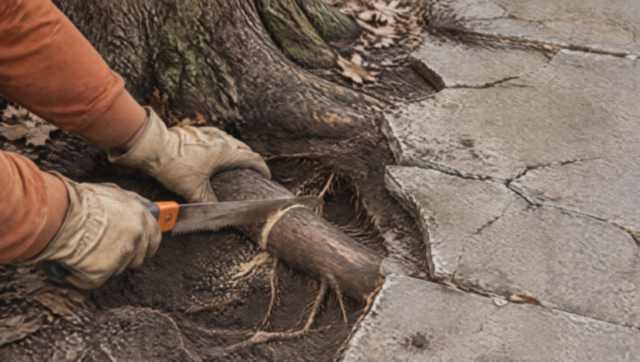
What does a root barrier actually do?
Roots that reach it turn down or run along it instead of carrying on toward whatever you're protecting. It goes between the tree and the problem, usually along a boundary, a driveway edge, a pipe run or a slab.
Running bamboo gets the same treatment: Weeds Australia says golden bamboo can be controlled with an underground barrier, and a Gardening Australia presenter told the ABC that means digging down about 600 millimetres. For a tree, the depth, material and line are the arborist's call. Our bamboo guide covers the bamboo side.
What won't a root barrier fix?
It won't undo damage already done or keep roots out of a broken pipe. Hobsons Bay City Council says roots usually get into pipes through existing faults such as leaking joints, and Wyndham City Council says leaking stormwater pipes flood the soil and attract roots. Fix the pipe first.
It may not fix cracks in the house either. Wyndham says many homes in its area sit on reactive clay, which swells when wet and shrinks when dry, and that blaming roots alone for building movement is an oversimplification. See our tree roots and your house guide.
Can a root barrier hurt the tree?
Yes, because the trench cuts roots, and some of them hold the tree up. Hume City Council describes the structural root zone as the roots and soil a tree needs to stay stable, and says breaching it substantially increases the chance of the tree falling over. City of Darwin's 2018 report linked many of its storm failures to roots being cut or damaged.
The City of Sydney says many eucalypts are less tolerant of root interference. AS 4970:2025, the Standard for protecting trees on development sites, grades encroachment into a tree's Notional Root Zone as minor, moderate or major, and Inner West Council in Sydney wants root pruning assessed by someone with at least AQF Level 4.
Before any trench is dug
Find out what's underground. Lodging an enquiry with Before You Dig Australia (BYDA) is done through byda.com.au or its app, and BYDA says to decide who will lodge it before any contractor starts digging. Its plans are only indicative and may miss what's inside your boundary, and private services such as irrigation pipes or a cable to the shed won't be on them at all, so BYDA suggests a skilled locator.
Does a root barrier need council approval?
It can, because councils count root damage as damage to the tree. Georges River Council lists root pruning and root barriers among works needing its approval. Cumberland's DCP needs consent to prune live roots greater than 30mm, Ku-ring-gai counts severing roots 50mm or more as injuring a tree, and in the ACT, harming a protected tree's roots by cutting, ripping or compacting soil counts as damage.
If it's the neighbour's tree, what you can do about roots crossing the boundary depends on your state: see our neighbours' trees guide, and ask the council before any roots are cut.
Tree root removal: what you can do yourself
You can
- Lodge the BYDA enquiry and keep the plans.
- Have a plumber check the pipes with a camera.
- Fix leaking downpipes and stormwater connections.
Leave to an arborist
- Working out which roots matter and where a trench can safely run.
- Cutting roots cleanly, to the Standard.
- Deciding whether a barrier, root pruning or nothing at all is the right call.

Hiring an arborist for tree roots
We'd find the real cause before anyone digs: a plumber's camera for pipes, an engineer for cracks. If roots really are the problem and the tree is worth keeping, we'd have an arborist mark where a barrier can go without cutting the roots that hold the tree up, and get the council's answer before the first spadeful.