
Why isn't a big tree just cut at the base?
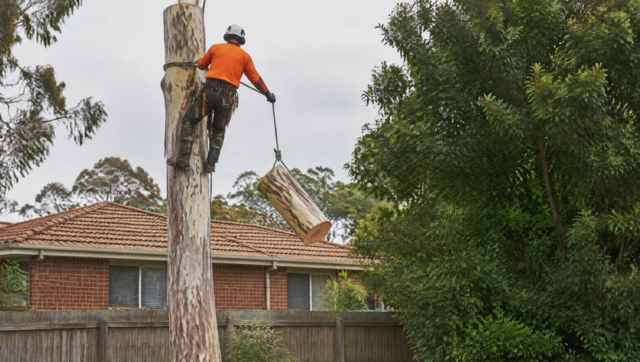
Dropping a tree in one piece needs clear ground at least as long as the tree is tall, and most suburban blocks don't have it. So an arborist takes it apart from the top down, branches first, then the trunk in lengths. That's called sectional dismantling, and each piece is lowered under control on ropes or lifted out on a crane's hook.
When does a crane make sense?
When there's nowhere safe to lower pieces, when the tree leans over the house, or when it's too decayed to work from. Safe Work Australia says a competent person should check a tree for decay, hollows and root plate failure before anyone works on it, and that check often decides the method. A crane needs firm, level ground near the tree, usually the driveway or the street.
Some jobs use an elevating work platform (a cherry picker) instead. Safe Work Australia says a boom-type platform with a boom of 11 m or more needs a high risk work licence to operate.
What makes a big removal bigger?
Access, mostly: how far the tree is from where a truck can park, and whether a chipper fits down the side or every branch gets carried out by hand. Steep blocks, pools, solar panels and power lines all add time.
If other trees are staying, ask where the crane and truck will stand. Around its own trees, Wyndham City Council doesn't permit parking or storing equipment inside a tree protection zone, because machinery compacts the soil over roots. See our tree protection zones guide.
On the day, stay out of the work zone
Safe Work Australia says an exclusion zone should be set up below and around a tree being worked on, because people near tree work are among those most at risk. Keep children, pets and cars well away, and don't stand underneath to watch. Leave any branch near a power line alone: Ausgrid, for one, says clearing inside the no-go zone around its lines can only be done by companies it contracts. Our power lines guide shows which network to call.
Will a big tree need a permit?
Very likely, because size is what most rules measure. In Victoria, clause 52.37 counts a tree at least 5 metres tall with an average canopy at least 4 metres across as a canopy tree. In the ACT, a living tree on private land is protected at 8 metres tall, an 8 metre canopy, or a trunk 1 metre around at 1.4 metres. In NSW, each council's development control plan decides. Ask the council before anything is cut, starting from tree removal permits.
What a quote for a large removal should spell out
- The method: ropes, a crane, a cherry picker, or a mix.
- Where the crane, truck and chipper will stand, and who sorts out using the street.
- How the roof, pool, fences and garden will be protected.
- The stump and the wood: ground or not, chipped and taken, or left for you.
- Who applies for council approval, and that work waits for it.
- Proof of public liability insurance. Financial Rights Legal Centre warns you may have to pay for damage an uninsured contractor causes.
Tree removal: what you can do yourself
You can
- Get the council's answer in writing.
- Photograph the tree and everything under it.
- Measure gates and side paths, and note where a truck could park.
- Tell the neighbours early, and clear cars and furniture on the day.
Leave to an arborist
- Every cut, rope and lift above the ground.
- Choosing between ropes, a crane or a platform.
- Anything near a power line, which is the network's call first.
Hiring an arborist for tree removal
We'd want the arborist on site before anything is quoted, walking the access with you and looking up into the tree. Then we'd only say yes to a written quote that names the method, where the gear will stand and who's applying for the permit. If a quote can't answer those three things, it isn't finished yet.