
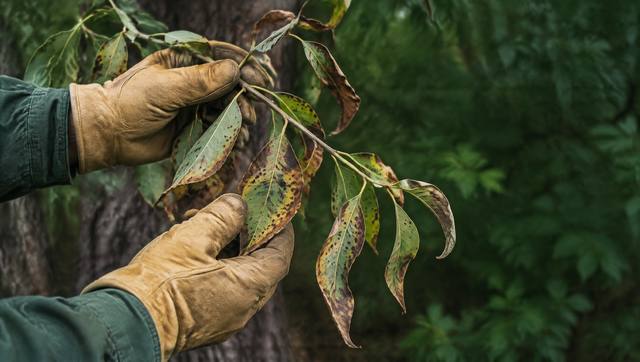
Signs a tree needs a health check
- Sudden leaf loss, new leaves that don't appear, or flowers that don't open.
- Shoots sprouting straight from the trunk or big branches (epicormic growth).
- Lots of dead or rotten branches on the ground.
- Tiny round or slightly oval holes in the bark, with sawdust-like frass (borer droppings) below.
- The root ball lifting, or the ground moving at the base on a windy day. Only watch from a safe distance.
What's usually wrong?
Borers. Usually the larvae of beetles or clearwing moths, feeding on living wood. Gardening Australia says they go for stressed trees and, over time, can weaken branches until they break or ringbark the tree.
Termites. Coptotermes acinaciformis is typically found in dead stumps, root crowns and the bowls of trees, often eucalypts and oaks, and Porotermes adamsoni nests in living eucalypts. A report after Cyclone Yasi found termite damage in urban trees was widespread but hard to diagnose.
Phytophthora dieback. A disease that infects and kills roots. In WA's south-west, over 40 per cent of native plant species are considered susceptible, and Toowoomba has found it in parks and some street trees.
Myrtle rust. A fungal disease that can affect eucalypts, paperbarks, lilly pillies and bottlebrush.
In Perth, add polyphagous shot-hole borer. City of Swan says not to prune, remove or dispose of a suspected tree until you've had advice from DPIRD, and to report it on the Exotic Plant Pest Hotline. Our pests and diseases guide covers each one in depth.
How does an arborist check a tree?
They look at the whole tree: leaves and new growth, the bark and any holes, the base, the root plate and the soil. Safe Work Australia's visual tree assessment, looking for decay, hollows and root plate failure, is the starting point. Where decay could be hidden, they may test: City of Sydney arborists found decay that had spread into a Moreton Bay fig's supporting roots with a drill test.
Diagnosing health and risk is consulting arborist work, at the Diploma of Arboriculture level, and if the council needs it in writing it becomes an arborist report.
Can my tree be saved?
Often, if it's caught early and the cause can be fixed. Stress sits behind a lot of problems, which is why Gardening Australia calls keeping a tree healthy the first defence against borers.
Some problems can be treated. Toowoomba Regional Council says some trees with Phytophthora can recover with good plant health and drainage, and that soil drenching and stem injection may help. Tree injection, where an arborist puts a treatment into the trunk, is also how Hobsons Bay treats its elms, in the cooler months on a two-year cycle.
Sometimes it can't. Whitehorse describes a dying tree as one in advanced decline that reasonable management can't keep, with a useful life expectancy under 3 years. And lopping a sick tree tends to backfire: Wingecarribee Shire says topping cuts a tree's strength and vigour and brings on early decline.
Does the council need to know?
If the tree might be pruned hard or come out, check first. In NSW, since the 2026 changes, pruning or removing a protected dead or dying tree needs a council permit or Native Vegetation Panel approval, and elsewhere councils such as Darebin want an arborist's evidence. See our permit pages and dead and dangerous trees.
Tree health checks: what you can do yourself
You can
- Photograph the symptoms every few weeks so changes are easy to see.
- Water deeply through dry spells and mulch over the root zone.
- Keep cars, bins and building materials off the root zone.
- Don't move soil from around a tree you think has dieback.
Leave to an arborist
- Working out the cause, including any testing.
- Injections, soil treatments and anything chemical.
- Dead branches above head height.
- Deciding whether the tree is safe to keep.
Questions to ask at a health check
- What do you think is causing it, and how sure are you?
- Is testing worth doing before any treatment?
- What treatment would you suggest, how often, and how will we know it's working?
- Is the tree a risk to people or the house right now?
- Do council or quarantine rules apply here?

Hiring an arborist for a tree health check
Get it looked at early, while there are still choices. We'd photograph what we were seeing, then pay for a diagnosis before paying for a treatment. And we'd be wary of anyone whose fix for a struggling tree is to lop it.