
When do you need an arborist report?
There are three common reasons. The first is a council application. Banyule asks for a report if four or more trees are involved, a tree is on its significant tree register, or the work is tied to a development. City of Onkaparinga needs one before deciding on removing a tree in danger of falling. In NSW, protected dead and dying trees now need approval, and Ryde wants an AQF5 arborist's tree risk assessment for them.
The second is building or renovating near trees. AS 4970:2025, the standard for protecting trees on development sites, covers arboricultural impact assessments (how the works will affect each tree), tree protection plans and monitoring trees through construction. Yarra Ranges asks for a report if proposed work comes within 15 metres of a tree.
The third is tree risk: a tree that's cracked, leaning or dropping limbs. Darebin wants a tree risk assessment when risk is the reason for removal, and Kingston asks for an internationally recognised risk method when the reason is health and safety.
Not every council insists. Boroondara doesn't require a report because its own arborist inspects the tree, and Ku-ring-gai doesn't either, though any report you include must follow its guidelines. Ask before you book.
Who can write an arborist report?
A consulting arborist. The Diploma of Arboriculture (AHC50524) is the qualification for consulting arborists, who assess trees and report on tree health and risk, and it sits at AQF Level 5. The trade qualification, the Certificate III in Arboriculture (AHC30824), is AQF Level 3.
Councils draw the same line. Wingecarribee Shire says an AQF Level 3 arborist does practical tree work but isn't qualified to prepare formal reports, and Blacktown says only an AQF Level 5 consulting arborist can declare a tree dangerous or dying.
There's no arborist licence in Australia, so qualifications are what to ask about. Arboriculture Australia's Registered Consulting Arborist level needs AQF Level 5, public liability and professional indemnity insurance, and 12 continuing education units a year. It's an industry credential, not a government licence. Our guide to checking an arborist goes further.
Should the report writer be independent?
Some councils say so. Willoughby only accepts reports from a consultant arborist with at least AQF Level 5 who follows AS 4373 and AS 4970 and isn't financially tied to a tree removal or pruning company. Bayside asks for an independent qualified arborist, with a risk assessment using a recognised method. Even where it isn't required, a recommendation is easier to trust from someone who isn't also quoting the removal.
What about tree protection zones?
If you're building, the report sets out each tree's tree protection zone: the area above and below ground that has to be left alone during the works. Hobsons Bay, citing AS 4970:2025, calculates it as the trunk diameter measured 1.4 metres above the ground, multiplied by 12. Our tree protection zones guide explains how they work on site.
How does an arborist put a report together?
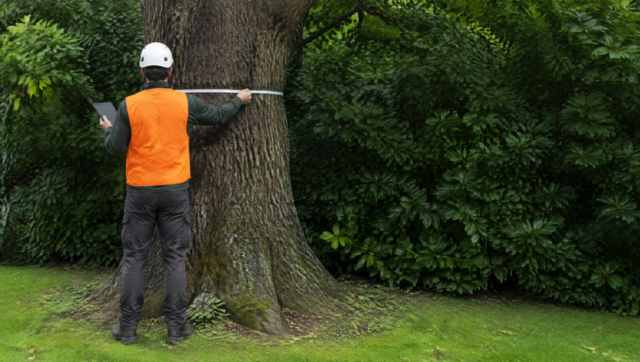
It starts on site. Safe Work Australia describes a visual tree assessment by a competent person, looking for decay, hollows and signs the root plate is failing. The arborist measures each tree, records its health and structure, and photographs it.
Some trees need more. City of Sydney arborists used a drill test to find decay hidden at the base of a Moreton Bay fig, and Glen Eira says root investigation may be needed before works near a tree.
What a good arborist report includes
- Each tree identified by number, with a photo, its botanical and common names, and its spot on a site plan.
- Measurements, health and structure for every tree assessed.
- Tree protection and structural root zones under AS 4970:2025, where there's building work.
- A risk assessment using a recognised method, when safety is the reason.
- The reasons for the recommendation, the alternatives considered and any remedial work.
- The arborist's qualifications, and a timetable for the work.
- The council's own report guidelines, where it has them. Hornsby and Ku-ring-gai won't consider reports that don't follow theirs.
What makes a report bigger or smaller?
How many trees, and what it's for. One back-yard tree for a permit is quick. An arboricultural impact assessment for a building site with dozens of trees isn't.
Testing. Decay testing or root investigation adds time on site.
Return visits. On a building site, monitoring through construction means the arborist comes back.
Arborist reports: what you can do yourself
You can
- Ring the council and ask whether it wants a report for your job, and who may write it.
- Download any report guidelines or template the council publishes.
- Gather a site plan, photos, and what you've noticed: cracks, lean, dropped branches and when.
- Keep the report and photos afterwards. Blacktown says to keep them as proof.
Leave to an arborist
- The site assessment, measurements and risk rating.
- Decay testing or root investigation.
- Working out protection zones under AS 4970:2025.
- Any pruning or removal afterwards, by whoever you choose.

Hiring an arborist for a report
Before booking anyone, we'd ring the council and ask three things: do I need a report for this, who's allowed to write it, and is there a template? Then we'd book an AQF Level 5 consulting arborist who isn't quoting the removal. A report written to the council's own checklist gets read, and one that ignores it can get sent back.