
Grind it, dig it out or leave it?
| Grind it | Dig it out | Leave it | |
|---|---|---|---|
| Suits | Most stumps, and anything big | Small stumps from shrubs and young trees | Corners you don't need for anything |
| Who does it | An arborist or stump grinding business | You, with hand tools | Fungi, insects and time |
| What's left | A hole of grindings and soil, with deeper roots left to rot | A hole to fill, with the main roots out | A stump for years |
| Watch for | Pipes and cables underneath, and flying debris | Your back, and anything buried | Fungi, termites and trips |
Find out what's underground before you dig or grind
Pipes, cables and irrigation lines often run close to old trees. BYDA says homeowners should lodge a Before You Dig Australia enquiry before they start. Its plans can miss what's inside your boundary, and anything privately installed won't show at all. Safe Work Australia's tree work guide says to check for underground services around a stump before grinding, contacting BYDA if the grind will go deeper than 200mm or services are a concern. If your spade hits a pipe, a cable or concrete, stop there and get help.
Option 1: have it ground out
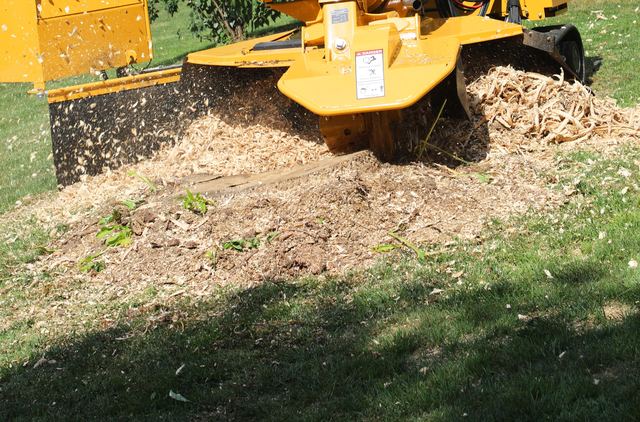
Grinding is the usual answer for anything bigger than a shrub. A stump grinder uses a spinning cutting wheel to chew the stump and its surface roots away to below ground level. Deeper roots stay in the ground and rot slowly.
Ask how deep the grind will go and get it in writing. There's no single standard for home jobs, but as a benchmark Mitchell Shire Council grinds its own stumps to at least 30 cm below natural ground level and grubs out the surface roots.
We don't give instructions for running a grinder yourself. Safe Work Australia lists roll-over, contact with the grinding wheel, being struck by thrown material, noise, dust and live underground services among the hazards, and says the area should be checked for stones, pipes, metal and concrete first. It's work for someone who does it every week. Our stump grinding page explains what to expect on the day.
Option 2: dig out a small stump by hand
Make sure it's small
This is for stumps from shrubs and young trees, the kind that already shifts a little when you push it with your foot. If the roots are too thick for a pruning saw, have it ground instead.
Check what's underground
Lodge the BYDA enquiry, and think about anything you or a past owner put in yourselves: irrigation, garden lights, a cable to the shed.
Dig a ring around it
Use a spade to dig a trench around the stump, about a spade's width out, until the main roots show. Wear gloves, closed shoes and eye protection.
Cut the roots as you find them
Cut exposed roots with loppers or a pruning saw, keeping the blade well away from your feet and hands. Work your way round until the stump rocks.
Lever it out and fill the hole
Rock it loose and lift with your legs, not your back, and get a second person if it's heavy. Fill the hole with soil, firm it down, and top it up as it settles.
Option 3: leave it to rot
It's the slowest option and the least work. A low stump can be planted around, or used as a seat or a stand for pots, while it breaks down.
The trade-off is what moves in. Gardening Australia says fungi often grow on stumps, that a large tree's root system can feed them for decades, and that removing the stump cuts their fuel and helps protect your living woody plants. Termites like old stumps too: a South Australian Museum zoologist told the ABC that one common termite, Coptotermes acinaciformis, is typically found in dead stumps and root crowns, and can move up to 50 metres underground looking for food.
Gardening Australia notes the other common approach is cutting the stump to ground level and poisoning it. We don't give chemical instructions on this site. If you go that way, follow the product label exactly.
Will the stump grow back?
Some do. Many eucalypts form an underground lignotuber that lets them regenerate after damage or fire, and Gardening Australia shows a mallee regrowing after being cut low. Some weeds are worse: Weeds Australia says tree-of-heaven has been reported suckering from its roots for at least 4 years after the tree is cut down, sometimes many metres away. Brisbane City Council says jacaranda resprouts easily if damaged, and running bamboo spreads by rhizomes that travel well beyond the clump.
Grinding the stump and surface roots stops a lot of regrowth. For a tree known to sucker, cut new shoots off at ground level as soon as they appear, and ask the arborist about a follow-up visit.
Is it your stump to remove?
A stump on the nature strip belongs with the council's trees. In NSW, work on a tree on public land needs approval first, and in Canberra residents aren't permitted to remove street trees. Ask the council before touching a verge stump.
Think about the roots of trees that are staying, yours or the neighbour's. Grinding or digging can cut them, and some councils count that as damage: Ku-ring-gai's DCP treats severing roots 50mm or more in diameter as injuring a tree. If the stump is close to a tree you're keeping, ask how the arborist will avoid its roots.
Your part, and what to hand over
You can
- Dig out small shrub stumps with a spade, loppers and a pruning saw.
- Lodge the BYDA enquiry before any digging or grinding.
- Cut regrowth shoots off as they appear.
- Fill and top up the hole once it's ground.
Leave to an arborist
- Grinding, and any stump from a full-size tree.
- Stumps near pipes, the house slab or a tree you're keeping.
- Follow-up for species that sucker.
- Taking the grindings away if you'd rather not keep them.

How to remove a tree stump: what to do next
For anything bigger than a shrub, we'd have it ground, with the depth in writing and the services located first. We'd only dig by hand where the stump already moves when you push it. And we wouldn't leave a big stump to rot beside the house.
Want an arborist to look at it?
Tell us the job and your postcode, and a local arborist calls you to talk it through.