
Land clearing permits in Sydney
In urban, environmental and conservation zones, Chapter 2 of the Biodiversity and Conservation SEPP applies. Your council issues the permit for trees its DCP protects, as long as the clearing sits under the Biodiversity Offsets Scheme thresholds and isn't part of a development application.
Above those thresholds, clearing that isn't linked to development needs Native Vegetation Panel approval, backed by a biodiversity assessor's report. Clearing that's part of a build goes through the development application instead.
Rural land used for farming runs on a separate system. Local Land Services handles it under the Land Management Framework, and takes calls about the rules.
Land clearing in Sydney: what's local
Cumberland Plain Woodland
This critically endangered grey box and forest red gum woodland is down to 9 percent of its original extent, on heavy clay across the Cumberland Plain. Penrith names it, with Shale Sandstone Transition Forest and Agnes Bank Woodland, among critically endangered communities in its area.
Biodiversity mapping
Blacktown says 10/50 exemptions don't apply to land on the NSW Biodiversity Values Map or on conservation maps in the Blacktown LEP 2015, or to heritage-listed properties.
Shale forests in the north and south
Blue Gum High Forest and Sydney Turpentine-Ironbark Forest survive in remnants from Hornsby and Ku-ring-gai down to Sutherland and Hurstville. Turpentine-ironbark forest has only 0.5 percent of its original extent left intact.
Bush edges and 10/50
The 10/50 Code only reaches land inside a mapped entitlement area, and not critically endangered communities, slopes over 18 degrees, or land within 10 metres of a river or lake. Check the RFS online tool on the day.
Land clearing in Sydney: good to know
If any of the clearing relies on 10/50, the RFS rules out clearing methods that disturb the soil profile, such as graders, ploughs, dozers or excavators. It also says vegetation must not be removed below the soil surface and a protective ground cover should stay on the soil. That's a long way from what many people picture as clearing a block.
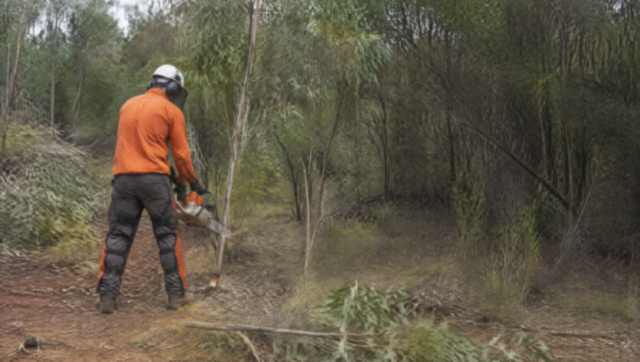
Mulching on site is common on clearing jobs, and it can help hold that ground cover. Ask the arborist what gets chipped and left, what gets taken away, and how bare soil on a slope will be protected from the next downpour.
Questions to ask about land clearing in Sydney
- Exactly what's being cleared, marked on a site plan
- Which approval covers it: council permit, Native Vegetation Panel, development application, 10/50 or Local Land Services
- Whether any of the vegetation is a threatened community, and who checked
- The machinery used, and how the soil and topsoil are protected
- What happens to the material: mulched on site, chipped or carted away
- Erosion control on sloping ground
- Trees being kept, and how they're protected while the work goes on

Hiring an arborist for land clearing in Sydney
Get the approval question answered in writing before any machine is booked, because clearing the wrong vegetation in Sydney can end in court. If the block has native trees on clay in the west, assume Cumberland Plain Woodland could be involved and have an ecologist or consulting arborist check before anything is touched.