
How big do gum trees get?
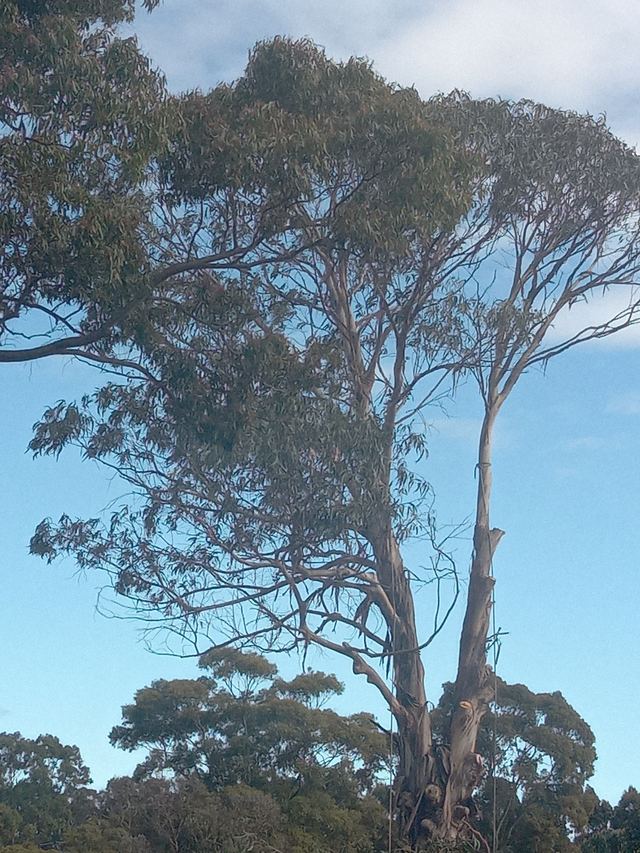
That depends on which gum. PlantNET counts more than 800 Eucalyptus species, all but 16 found only in Australia. As street trees, the City of Sydney expects 18 to 25 m from a spotted gum and 20 to 28 m from a Sydney blue gum, and the Tasmanian blue gum can reach 70 metres in tall open forest in south-eastern Tasmania.
At the small end are mallees. Many eucalypts form a lignotuber, a woody swelling at or below ground that lets them regrow after damage or fire, which Gardening Australia says is why mallees can be coppiced (cut back hard to the base).
Can a healthy-looking gum drop a limb?
Yes. The ABC reported in January 2025 that eucalypts are known to drop limbs after hot weather or during high winds, and an experienced arborist said few signs forecast it: a branch can look sound and then suddenly give way. The odds for any one person are tiny (a senior arborist put deaths at around one per 5 million people), but it makes sense not to park, camp or set up a play area under heavy limbs on hot or windy days. Keep well clear of any branch that's already cracked or hanging.
Why do gums mind their roots being disturbed?
The City of Sydney says many eucalypts are adapted to well-drained, low-nutrient soils, so they're less tolerant of root interference such as compaction, waterlogging and damage. Driveways, trenches, retaining walls and regular parking over the root zone are the usual culprits. It also notes that gums grown fast in rich conditions with no fire may become structurally weak.
Pipes are a separate worry: Bundaberg Regional Council lists gums among the trees it doesn't recommend planting near sewer pipes. Termites are worth knowing about too. One species is commonly found in eucalypts, typically in dead stumps, root crowns or the bowl of the tree, and the ACT says another nests in living eucalypts. Our pests and diseases guide has the signs.
What's yours to do, and what isn't
You can
- Snip low sprouts and small twiggy growth you can reach from the ground, using secateurs or loppers.
- Keep cars, building materials and soil piles off the root zone.
- Watch for shoots sprouting along the trunk or branches, which Gardening Australia lists among the signs a tree may be in decline.
- Photograph cracks, splits and any limb that has changed angle, with the date.
Leave to an arborist
- Any limb you'd need a ladder or a pole saw to reach.
- Taking weight off long limbs over the house, the driveway or next door.
- A risk assessment of an old gum, or an arborist report for the council.
- Removal, which on a big gum is usually done in sections.
Is my gum tree protected?
Often, and councils name eucalypts outright. Orange City Council protects White Box, Yellow Box and Blakely's Red Gum regardless of size. The City of Whittlesea gives River Red Gums extra protection under its planning scheme, and Manningham's overlays even cover some dead eucalypts. In South Australia, the 3 metre rule for trees near a house or in-ground pool doesn't reach eucalypts at all.
Poisoning one doesn't get around the rules. In June 2025, a Monash resident who poisoned an established 18m lemon-scented gum on Vegetation Protection Overlay land was fined $9,000 without conviction at Ringwood Magistrates' Court. Find your council on the tree removal permits page before any heavy pruning or removal.

Gum trees (eucalypts): what to do next
We'd have an arborist look at any gum that leans over the house, the driveway or where people sit, and we'd ask for weight reduction on the long limbs rather than lopping, which leaves weak, poorly attached regrowth. Then we'd take the arborist's findings to the council before anything big is cut.
Want an arborist to look at it?
Tell us the job and your postcode, and a local arborist calls you to talk it through.