
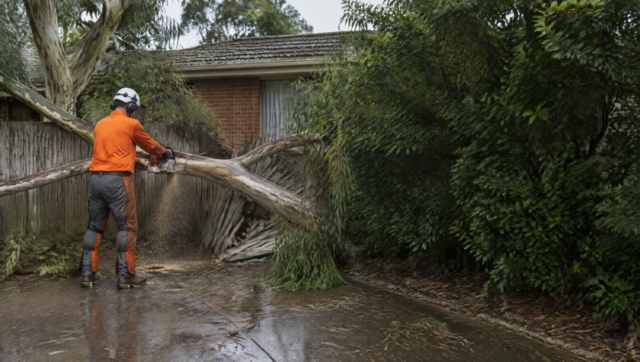
What to do right now
Call 000 if anyone is hurt, trapped or in danger. For storm damage to your home, call the SES, whichever state or territory you're in. Stay away from hanging or split branches, because they can drop without warning, and keep children, pets and cars clear of the tree. Treat any fallen power line, and anything touching it, as live: stay well back (Ausgrid and Western Power say at least 8 metres, SA Power Networks says 10), warn others and call the electricity network's faults line. A tree on a street power line is the network's job, not an arborist's.
Once everyone's safe
Photograph everything
Moneysmart says to take photos and video of the damage before you move anything. Get the whole tree, where it broke, and whatever it landed on.
Ring your insurer
Talk to them before you pay anyone. The Insurance Council of Australia says to speak to your insurer before you attempt or authorise any building work, even emergency repairs. Moneysmart adds that many insurers can arrange emergency work themselves.
Let the SES make it safe
SES volunteers do temporary work, such as tarping a damaged roof or removing a dangerous fallen tree. For permanent repairs, the SES points you to your insurer or a private contractor.
Then call an arborist
Once the area is safe, an arborist can take down what's hanging, cut up what's fallen and tell you whether the rest of the tree can stay.
What does an arborist do after a storm?
First, they look. Safe Work Australia says a competent person should check a tree for decay, hollows and root plate failure before anyone works on it, and notes that strong winds can weaken trees and dislodge hanging branches. After a storm that check matters more, with wood under strain and limbs resting on other limbs.
Then it's usually one of three jobs: clearing what's on the ground, taking down hanging or split limbs, or removing a tree that has lost its footing. A tree that looks wrecked can sometimes be kept with careful pruning, and one that looks fine can have a crack that means it has to go.
Storm jobs sent through this site are marked urgent for the arborist, but after a big storm every arborist is stretched, and nobody can promise how fast anyone gets to you. That's why making it safe comes first.
Will insurance cover a fallen tree?
Policies differ a lot, so read your Product Disclosure Statement (PDS) and ask your insurer; nothing here is a promise of cover. Moneysmart says most home and contents insurance covers storms, including strong winds.
Removing the tree is where people get caught out. Financial Rights Legal Centre says some policies only cover removing a fallen tree if it damaged the insured home or contents.
Liability depends on the tree. If a strong, healthy tree falls in a storm, the owner usually isn't liable, because it's treated as an act of God. If it was dead, damaged or a species known to drop branches, the owner may be. A damaged boundary fence is usually split between neighbours, each insurer covering its own customer's share.
Watch out for disaster chasers. After a 2021 Sydney storm, the Insurance Council warned about people offering tree removal for cash upfront, then leaving the work poorly done or unfinished. A tradesperson working for your insurer won't ask you for payment.
Do storm-damaged trees need a permit?
They can. A storm doesn't switch off the council's tree rules, and a damaged tree that's still standing may still be protected. Ask the council before it's cut down.
In NSW, a tree can only come down under the risk exemption if the council agrees it poses an imminent safety risk and confirms that in writing before work starts, though the NSW SES and Fire and Rescue NSW can act in an emergency. In the ACT, Access Canberra takes calls for an urgent circumstances authorisation, and a full application follows. See the NSW and ACT permit pages.
Other states have their own processes, on our permit pages. Either way, photograph the damage before anything is cut, because council may want to see it.
Storm damage: what you can do yourself
You can
- Photograph the damage before anything is moved
- Keep people, pets and cars well away from the tree
- Rake up leaves and twigs that are well clear of the damaged tree
- Call your insurer, and the council if the tree is still standing
Leave to an arborist
- Hanging, split or tangled branches, at any height
- A fallen trunk or limb that's under strain or resting on something
- Deciding whether a damaged tree can stay
- Never a tree on a power line: that's the network's job, not an arborist's and not yours

Hiring an arborist for storm damage
Make it safe and take the photos before you think about the tree. Ring the insurer before you pay anyone, and say no to anyone at the door asking for cash upfront. Then have an arborist look at the whole tree, not just the bit that fell, because a tree that's dropped one limb sometimes has another one waiting.