
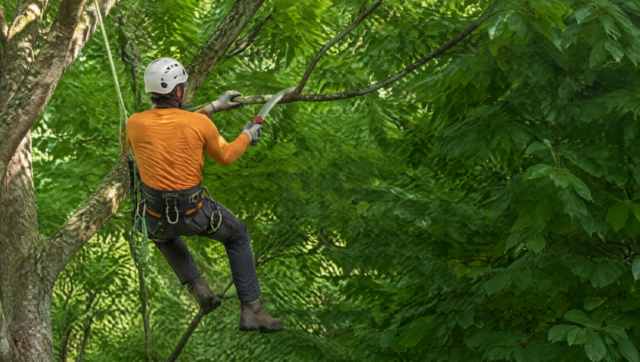
What does pruning to AS 4373 mean?
AS 4373-2007, Pruning of amenity trees, is the Australian Standard for pruning trees in gardens, streets and parks. It sets out the types of pruning (deadwooding, crown thinning, selective pruning, formative pruning, reduction pruning, crown lifting, pollarding, remedial pruning and line clearance) and lists lopping, topping, flush cutting and wound painting as unacceptable.
Some councils write it into their rules. In the ACT, pruning must follow AS 4373 or MIS 308 Tree Pruning, and in Wingecarribee Shire in NSW all pruning must follow AS 4373 unless an AQF Level 5 arborist (the consulting level) specifies otherwise.
Where the cut goes matters as much as which branch comes off. Whitehorse City Council explains that a branch should be cut just outside the branch collar, the swelling at its base, because that tissue is what grows over the wound. Where the collar can't be seen, the branch bark ridge (a wrinkle in the bark where branch meets trunk) is the guide.
Lifting, thinning or reducing: which one do you need?
Crown lifting takes off the lowest branches so you can walk, mow, park or see under the tree. The crown (the leafy top) stays the same, it just starts higher.
Crown thinning removes selected branches right through the crown, so more light and wind get through. Done well, you notice the extra light more than the missing branches.
Crown reduction shortens the outer branches back to smaller branches that can take over, so the whole tree is smaller but keeps its shape. It's what an arborist offers when someone asks for a lop. Not every species responds well, so ask about yours.
Deadwooding removes deadwood (dead branches still on the tree). On a big old tree it's often the first job, and the one most worth doing over paths, play areas and parked cars.
Our crown thinning and lifting page goes deeper on these, and fruit tree pruning has its own page.
Branches over the roof, gutters and solar panels
A lot of pruning starts at the house: leaves filling the gutters, a branch scraping the roof in the wind, or shade creeping across the solar panels. Usually the answer is selective pruning of the branches over the house, back to the trunk or a bigger limb, rather than taking the tree out.
Storms are another good reason. The Insurance Council of Australia suggests trimming branches that overhang the property before storm season, and notes that you may need a council permit to do it.
If the branches are near the power line running to your house, stop there. Who clears it depends on your state and your network, and it's never a homeowner job: SafeWork NSW says that if any part of a branch touches a line, the whole branch, leaves included, may be live. The power lines guide explains who to call.
Do you need council approval to prune a tree?
Sometimes, and more often than people expect, because permit rules aren't only about removal. In the ACT, major pruning of a protected tree (taking off branches more than 100 mm across) needs approval, and so does even minor pruning of a registered tree. In South Australia, excessive pruning of a regulated tree can count as tree-damaging activity.
The Victorian Government tells residents to ask their council whether a tree is protected, because a permit may be needed even to cut it back. In NSW, pruning a protected dead or dying tree now needs a council permit or Native Vegetation Panel approval too.
Big cuts on big trees are where approval most often comes into it, but some councils protect much smaller trees. Check the permit rules for your state and ask the council before any heavy prune is booked.
Tree pruning: what you can do yourself
You can
- Small branches you can reach with both feet on the ground, using secateurs, loppers or a pruning saw
- Dead stems and twigs, which Gardening Australia says can come off at any time of year
- Flowering and fruiting plants once the main flowering or fruiting has finished, Gardening Australia's general rule
- Deciduous fruit trees in winter while they're dormant (see fruit tree pruning)
- Every cut just outside the branch collar, never flush with the trunk and never leaving a stub
Leave to an arborist
- Anything you'd need a ladder or a climb to reach
- Branches over the roof, the house or the neighbour's yard
- Lifting, thinning or reducing a full-size tree
- Anything near a power line, including the line to your house
- Protected or registered trees, once the council has approved the work
What a pruning quote should spell out
- Which branches are coming off, described or pointed out on the tree, not just a tidy-up
- The type of pruning (lifting, thinning, reduction or deadwooding) and that it's to AS 4373
- Roughly how much of the crown will be removed
- Whether the council needs to approve it, and who's applying
- What happens to the branches and leaves, and whether the woodchips stay or go
- Proof of public liability insurance
Hiring an arborist for tree pruning
Walk around the tree and write down what's actually bothering you: the gutters, the shade on the panels, the dead limb over the path. Give the arborist that list, ask for pruning to AS 4373, and get the quote to name the branches. Gardening Australia's own advice for larger trees is to get expert help, and we agree. If the tree is big or protected, check with the council before the date is booked, not after.