
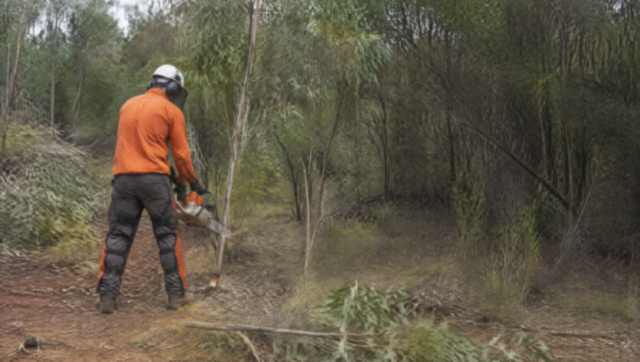
When is it land clearing, not just tree removal?
When it's the block, not the tree. Clearing for a new house or a subdivision, taking out regrowth or weeds on acreage, cutting a firebreak, or turning an overgrown back half into usable yard are all clearing jobs, and they usually take in the shrubs and groundcover too.
That catches people out, because clearing rules often reach past trees. Huon Valley Council says you often need approval before clearing trees, shrubs, grasses or groundcover, and Newcastle asks for an ecological assessment where more than five trees go or more than 200 square metres of native vegetation is cleared.
Who sets the clearing rules in each state?
| The main rules | Where to start | |
|---|---|---|
| NSW | Council DCPs on urban and zoned land; the Native Vegetation Panel above the Biodiversity Offsets Scheme thresholds; Local Land Services on rural land | Your council, or Local Land Services |
| Victoria | Clause 52.17 needs a permit to remove, destroy or lop native vegetation, dead included, unless one of its exemptions applies, plus overlays and local laws | VicPlan, then the council |
| Queensland | The state vegetation framework, protected plant rules, koala habitat in south east Queensland, and council rules | A vegetation management property report, then the council |
| WA | Clearing native vegetation without a clearing permit or an exemption is an offence | The council, and the Department of Water and Environmental Regulation |
| SA | Regulated and significant tree approvals apply even where the Native Vegetation Act 1991 might allow the work | The council |
| Tasmania | Planning scheme codes, including the Natural Assets Code | The council |
What else can apply?
Federal law sits over the top. Queensland's government and the Sunshine Coast both note that approval under the national EPBC Act may be needed where clearing significantly affects matters of national environmental significance.
Local thresholds matter too. Penrith says clearing 0.25 ha or more of native vegetation on a lot under 1 ha needs Native Vegetation Panel approval, and Yarra Ranges says a proposal affecting native vegetation on a property over 4000 square metres will most likely need a planning permit. For Canberra, start with our ACT permit page.
Wildlife, hollows and habitat trees
Old trees with hollows are often home to something. City of Moreton Bay says that where wildlife is present, a spotter catcher (a trained wildlife handler) should supervise the clearing, and work may need to stop until animals are moved.
Dead trees aren't automatically fair game. Moreton Bay counts removing a dead habitat tree as clearing, and Sutherland Shire requires hollows and nesting sites in dead trees to be kept. Even in a NSW 10/50 area, the RFS says landowners can still be prosecuted for harming protected animals.
Clearing for bushfire safety
Bushfire rules are their own system, and they're completely different from state to state. In NSW, the 10/50 rule covers trees within 10 metres of a home and shrubs, not trees, within 50 metres, only where the RFS online tool shows your address in a 10/50 area on the day, and never around power lines. Victoria has its own 10/30 rule in bushfire prone areas, and in WA each local government sets firebreak requirements by notice.
These are allowances with conditions, not a pass to clear a whole block. Read our bushfire clearing guide and, in NSW, the 10/50 rule explained before planning around them.
How do arborists clear a block?
It starts with a plan of what stays. Trees being kept get protective fencing around their protection zones before machines arrive. Then trees come down, branches go through a chipper or mulcher, and stumps are ground or dug out. Our tree removal and stump grinding pages cover those parts.
Good crews also think about what they carry in and out. People moving infested soil have spread Phytophthora dieback, a disease that kills roots, further and faster than anything else, so clean machinery matters. Perth's shot-hole borer quarantine area has its own rules for cleaning machinery and moving wood.
What happens to the mulch?
Chipped branches and leaves can be spread over garden beds and paths, stockpiled, or carted away. Spread over the root zone of a tree you're keeping, mulch protects the soil, which is why Banyule lists it among its tree protection measures for building sites. Ask where mulch from diseased or weedy trees is going before it's spread.
What changes the size of a clearing job?
Area, tree count and slope. A few trees on a flat house block, or a hectare of regrowth on a hillside.
Approvals. Assessments, wildlife spotters and permit conditions add time.
Stumps, services and mulch. Grinding versus digging out, locating pipes and cables first, and whether the mulch stays or goes.
Land clearing: what you can do yourself
You can
- Get the approvals, in writing, before booking the work.
- Mark the trees and areas you're keeping on a plan.
- Lodge a Before You Dig Australia enquiry, or agree who will.
- Hand-pull small weeds and seedlings.
Leave to an arborist
- Taking trees down, in sections where needed.
- Chipping, mulching and stump removal.
- Anything near power lines, buildings or boundary fences.
- Working around wildlife with a spotter catcher.
What a clearing quote should spell out
- Which approvals are needed, and who's getting them.
- Exactly what goes and what stays, marked on a plan or on site.
- Stumps: ground or dug out, and how deep.
- Mulch: spread, stockpiled or taken away.
- Machinery cleaning, and weed and disease hygiene.
- Wildlife checks or a spotter catcher, where needed.
- Public liability insurance and the final clean-up.

Hiring an arborist for land clearing
We'd sort the approvals before the quotes. Ask the council, and in rural NSW Local Land Services, what can go, and get the answer in writing. Mark what you're keeping, then have arborists quote on that plan. It's far easier to plan around a habitat tree than to explain its stump.