
Does it need to come out, or just be cut back?
Plenty of trees that worry people don't need to come out. One heavy limb over the roof, branches in the gutters or too much shade are usually pruning jobs, and pruning keeps the shade, the privacy and the tree.
Removal makes sense when the problem is the whole tree. It's dead or dying, the trunk is split or hollow, the roots are lifting out of the ground, or it's too big for where it was planted and will keep cracking paths, pipes or the house.
Some signs are easy to miss. Gardening Australia lists sudden leaf loss, new leaves that never appear and epicormic growth (shoots sprouting straight from the trunk or branches) among the signs of decline. If you can't tell, the dead or dying tree guide helps, and an arborist can assess it.
How do arborists take a tree down near a house?
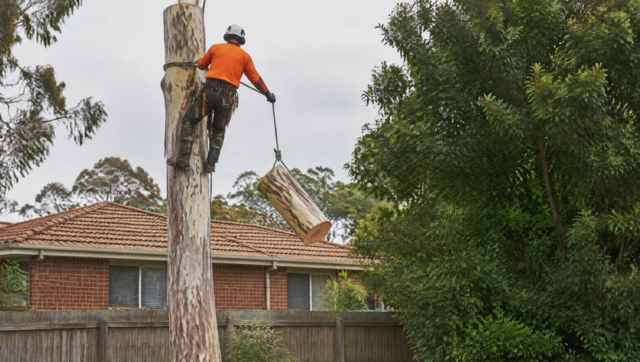
In open ground, a tree can sometimes come down in one piece. Next to a house, a fence or the neighbour's shed, it comes down in sections. The arborist works from ropes in the tree or from a cherry picker, and the pieces are lowered on ropes rather than dropped.
For a big tree, or a backyard with no way in, a crane can lift sections out over the roof. That's covered on our large and crane removals page.
Before anyone goes up, Safe Work Australia's guidance says a competent person should check the tree for decay, hollows and root plate failure, and an exclusion zone should be set up underneath. Expect the crew to ask you, the kids and the dog to stay well back.
What makes a removal a bigger or smaller job?
Height and spread. A tall tree with a wide crown (the leafy top) means more cuts, more lowering and more wood.
What's underneath. Roofs, pools, fences and the neighbour's veggie patch mean pieces have to be lowered, not dropped.
Access. A narrow side path, steps, or no way to get the chipper (the machine that turns branches into woodchips) into the backyard means more carrying, or a crane.
Condition. A dead, split or hollow tree can change how the arborist works on it, or whether anyone goes up it at all.
Power lines. A tree touching a street line is the electricity network's job before it's anyone else's.
What's left. Grinding the stump, carting every branch away or leaving the logs for firewood all change the day.
Do you need a permit to remove a tree?
Often, yes. The rules come from your state and your council, and councils side by side can be very different, so check yours on our tree removal permits page before anything is cut.
Don't assume a dead tree can simply come down. Since NSW's 2026 changes, protected dead and dying trees need a council permit or Native Vegetation Panel approval, which NSW Planning says is to stop people poisoning trees and removing them once dead. In Victoria, the Environmental Significance Overlay covers dead vegetation, and Boroondara needs a permit for canopy trees even when they're dead.
A nature strip tree is the council's question, not yours: in NSW, work on a tree on public land needs approval first. See the council street trees guide.
When you tell us a removal job, the form asks whether you already have a council permit and passes your answer to the arborist, so it's worth checking first.
What happens to the stump and the mess?
A removal usually leaves the trunk cut close to the ground. The stump is its own decision, to grind, dig out or leave, and the quote should say which. Our stump grinding page walks through it.
Clean-up varies. Some quotes include chipping every branch and taking it away, some leave the logs stacked, and some leave woodchips for the garden. Any of those is fine, as long as it's written down.
What a good written removal quote covers
- How the tree comes down: in one piece, in sections lowered on ropes, or with a crane
- Who applies for the council permit and any arborist report, and that nothing starts until approval is in hand
- Proof of public liability insurance, and workers compensation where the business has staff
- Whether the stump is ground and how deep, or left
- Where the branches, logs and woodchips end up
- How lawns, garden beds and fences will be protected
- Who's doing the cutting, and what qualifications they hold
Tree removal: what you can do yourself
You can
- Photograph the tree from a few angles: the base, any cracks, and what's underneath
- Check your council's rules before anything is cut
- Clear the way in: cars, bins, pots and outdoor furniture
- Keep everyone out from under a tree that's cracked or leaning
Leave to an arborist
- Any cutting above head height, and anything that needs a chainsaw
- Taking a tree down near the house, a fence or the neighbour's garden
- Judging whether a dead or split tree is safe to work on
- Anything near a power line
Hiring an arborist for tree removal
We'd get the permit question answered first, then have an arborist look at the tree in person before agreeing to anything. The written quote should say how the tree comes down, what's left behind and who's insured, and if any of that is vague, keep asking. Financial Rights Legal Centre warns that if a contractor isn't insured, you may have to pay for whatever they damage. And if the tree is cracked or leaning towards the house, keep people clear of it while the paperwork happens.