
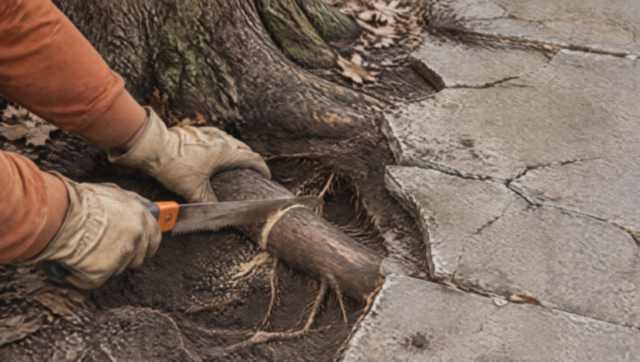
Before anyone digs near the roots
Find out what's in the ground first. Lodge a Before You Dig Australia enquiry (at byda.com.au or in its app) before work starts, and agree who is lodging it. The plans may not show services inside your boundary, and private ones such as irrigation lines or power to a shed won't be on them at all, so a locator may be needed.
Are the roots really the problem?
Often they're only part of it. Wyndham City Council says roots are just one cause of building movement and that blaming them alone oversimplifies things. It points to leaking or disconnected stormwater pipes, which soak the soil and draw roots in.
Pipes work the same way. Hobsons Bay says old terracotta pipes are the most common cause of leaks, and roots usually get in through faults that are already there, such as leaking joints. So for pipes, start with a plumber. For cracks in a slab or wall, start with a structural engineer.
Councils want that evidence anyway. Campbelltown asks for a plumber's report if a tree is damaging pipes, and City of Parramatta generally won't support blocked pipes as a reason for removal unless the problem is serious and recurring.
Why can cutting roots kill or topple a tree?
Roots hold a tree up as well as feeding it. Hume City Council describes the structural root zone as the roots and soil a tree needs to stay standing, with a larger area again needed to keep it alive, and says breaching it substantially raises the chance of the tree falling over.
It shows up in storms. City of Darwin's 2018 urban forest report found most storm tree failures across Greater Darwin came from a lack of maintenance or from roots being cut or damaged. Some trees take it worse than others: the City of Sydney says many eucalypts cope poorly with root damage, compaction and waterlogging.
How does an arborist deal with problem roots?
First they work out which roots matter: where they run, how thick they are and how far the damage is from the trunk. Roots well out from the trunk can often be cut cleanly and the tree left to grow on. Roots inside the structural zone usually can't.
Then comes stopping them coming back. A root barrier between the tree and the path or pipe sends new roots down or away. Sometimes the honest answer is that the tree and the structure can't both stay, and then it's a removal and stump grinding, which takes the stump and surface roots below ground level.
It's skilled work: Inner West asks for an AQF Level 4 arborist for root pruning assessments.
Do I need approval to cut tree roots?
Often, yes. Plenty of councils protect roots as well as branches. Ku-ring-gai counts severing roots 50mm or more across as injuring a tree, Lane Cove needs a permit for roots 40mm or more, and Cumberland needs consent to prune live roots over 30mm. Georges River lists root pruning and root barriers as work needing approval, and in the ACT, cutting a protected tree's roots counts as damaging it.
A neighbour's roots come under state rules. In Victoria you can cut back roots crossing your boundary at your own cost, after checking with the council, and Legal Aid WA says you can cut them back to the boundary while avoiding unnecessary harm to the tree. See our neighbours' trees guide for each state, and the permit pages.
Tree root removal: what you can do yourself
You can
- Get a plumber to check the pipes, and fix leaking stormwater pipes.
- Photograph cracks and lifted pavers with the date, so you can see whether they're getting worse.
- Ask the council what root size its rules cover before anything is cut.
Leave to an arborist
- Deciding which roots can go without harming the tree.
- Exposing and cutting roots near the trunk.
- Putting in root barriers, or removing the tree if it comes to that.
Questions to ask an arborist about roots
- Which roots will be cut, how thick are they, and how far from the trunk?
- Will the tree stay stable and healthy afterwards?
- Do council rules cover these roots, and who's applying?
- Would a root barrier stop the problem coming back?
Hiring an arborist for tree roots
Plumber or engineer first, arborist second. We'd find out what's actually causing the damage before anyone touches a root, then have an arborist decide what can be cut without putting the tree at risk, or the house it could fall on.