
What are the signs a tree is dying?
An arborist on Gardening Australia lists the early signs as sudden leaf loss, new leaves that never arrive, flowers that fail to open and any change to the way the tree normally grows. You know your tree's habits, so trust it when something looks off.
Watch for epicormic growth too: clusters of new shoots sprouting straight out of the trunk or main branches. Gardening Australia counts it among the signs a tree may be in decline. It's often the tree trying to replace a crown (the leafy top) it's losing.
Then look down. A NSW SES spokesperson told the ABC that lots of rotted or dead branches on the ground can signal trouble, and so can a root ball (the mass of roots and soil at the base) that's slowly working its way out of the ground.
Tiny round holes in the bark with sawdust-like frass around them point to borers. Our pests and diseases guide covers them.
Dead, dormant or just stressed?
A bare tree isn't always a dead one. Deciduous trees drop their leaves every year (jacarandas do it in early spring, English oaks before winter), so compare it with last year, or with the same species down the street.
For a quick check, scratch a thin twig you can reach from the ground. Green, moist wood under the bark means that part is alive. Brown and dry means that twig has died, though the rest may not have.
Gum trees are harder to write off. Many eucalypts have a lignotuber, an underground store that lets them shoot again after fire or damage, so a gum that looks finished can sprout from low down.
Councils have their own test, and theirs is the one that counts for a permit. Newcastle's DCP, for example, treats a tree as dead when its biological function has stopped: no leaves, and visible drying of the trunk, root plate and canopy.
How to check your tree safely from the ground
Stand back and look up
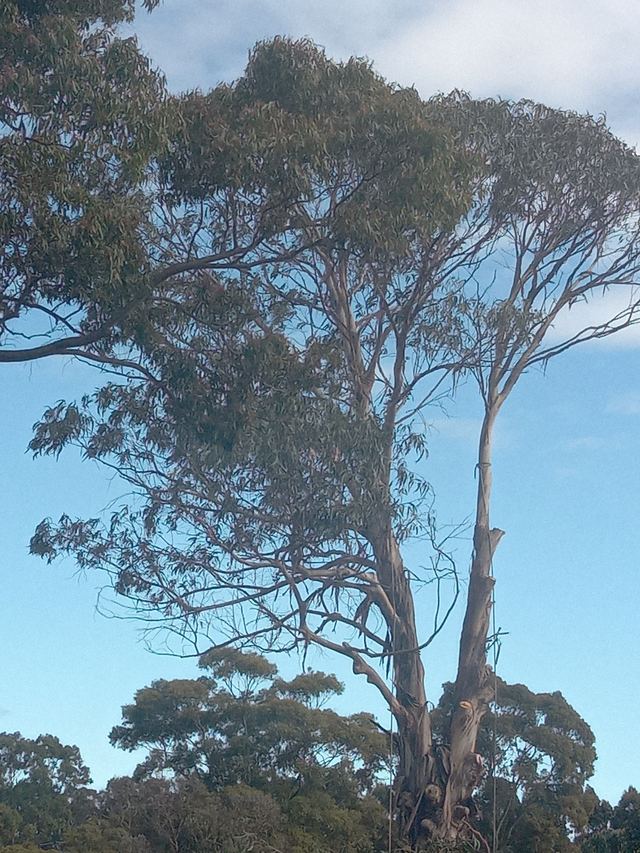
From well outside the reach of any branch, look at the crown. Is it thinner than last year? Are whole sections bare while the rest is in leaf?
Walk around the trunk
Look for cracks, splits running down from a fork, bark falling away, borer holes and fungus growing out of the wood.
Check the base and the ground
Cracked or heaving soil, roots lifting on one side and a new lean are the signs to take most seriously. The ABC reported advice to watch the base for movement on a windy day, but only when it's safe to do so, from a distance.
Notice what's falling
A few twigs after a blow is normal. Dead branches on the lawn every week isn't.
Take dated photos
Shoot the whole tree and the close-ups from the same spots each time. They help the arborist, the council and, if it comes to it, your insurer.
Make two calls before anything is cut
An arborist for the tree, and the council for the rules. The order matters less than making both.
Signs that need an arborist soon
- Soil cracking or lifting around the base, or roots pulling out of the ground
- A lean that's new, or one that's getting worse
- A split or crack running down into the trunk
- Large dead branches over the house, the driveway, a fence or where people sit and play
- Fungus growing from the trunk or the root flare (where the trunk widens into the roots)
Dead branches over the house or a path?
Keep people, pets and cars out from under it until an arborist has looked. Dead wood can let go without warning, so don't climb the tree, prop a ladder on it or try to pull branches down. If it's touching or near a power line, stay right away and use our trees and power lines guide to find the network to call. If a tree is coming down on the house in a storm, call 000 if anyone is in danger, and call the SES.
A dying tree near the house: who's responsible?
If a strong, healthy tree comes down in a storm, Financial Rights Legal Centre says the owner usually isn't liable, because it's treated as an act of God. That changes once the tree is dead or damaged: then you may be liable if it falls or causes damage.
The same factsheet says insurers won't pay to take down a tree you suspect is dangerous, so the decision is yours to make before a storm makes it for you. If you're unsure, Financial Rights suggests asking an arborist or the council whether the tree can come out. The Insurance Council suggests dealing with dead or rotting trees before storm season, noting you may need a council permit.
Does a dead tree still need council approval?
Often, yes. Dead doesn't mean it can simply come down, and the rules have been tightening.
NSW: under the 2026 changes, pruning or removing a protected dead or dying tree needs a council permit or Native Vegetation Panel approval, and the old exemptions no longer apply. NSW Planning says the change stops people poisoning trees and removing them once they've died. Even the imminent risk route needs the council's written agreement first, and Ku-ring-gai won't let work begin on a dead tree until it confirms in writing that the tree is dead and isn't needed as habitat.
Habitat matters because hollows in dead trees can be nesting sites for native animals. Sutherland Shire's DCP, for example, requires them to be kept.
Victoria: clause 52.17 needs a permit for native vegetation whether it's alive or dead, and a standing dead native tree with a trunk of 40 centimetres or more in diameter at 1.3 metres stays covered. Local laws can go further: Boroondara needs a permit for canopy trees even when they're dead.
ACT: a dead native tree on private land is protected once its trunk measures at least 1.88 metres around, 1.4 metres above the ground.
Where a council wants evidence, it's usually an arborist's report. Randwick asks for one for any dying, dead or dangerous tree. Everywhere else, our tree permit pages are the place to start, and the council is the place to finish.
What you can do, and what's arborist work
You can
- Photograph the tree from the same spots every few weeks
- Water deeply through dry spells and keep mulch over the root zone, clear of the trunk
- Snip small dead twigs you can reach with both feet on the ground, using secateurs or loppers, once you've checked the council's rules
- Ask the council what applies at your address, and keep the answer in writing
Leave to an arborist
- Judging whether a dying tree is safe to keep, and for how long
- Deadwooding (taking dead branches out of the crown)
- Removal, especially near the house, fences or power lines
- A written report for the council or your insurer
- Anything that needs a ladder, a climb or a chainsaw
Is my tree dead, dying or just stressed: what to do next
If dead branches hang over the roof, the driveway or anywhere people sit, we'd have an arborist assess the tree before the next windy day and ring the council the same week, dead or not. And we'd start keeping dated photos now. They make the arborist's job, the council's decision and any insurance conversation easier.
Want an arborist to look at it?
Tell us the job and your postcode, and a local arborist calls you to talk it through.