
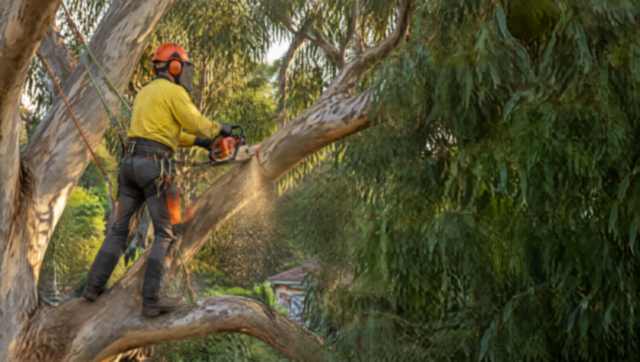
What do most people mean by tree lopping?
In a lot of Australia, and in Sydney and Brisbane especially, lopping is simply the everyday word for tree work. People ring a tree lopper to cut a gum back off the roof, take out a dead tree or clear branches off the fence. Nothing wrong with the word.
To an arborist, though, lopping is one particular way of cutting, and the one they'd rather not do to your tree.
What does lopping mean to an arborist?
Whitehorse City Council in Victoria defines lopping as removing stems or limbs between nodes, the growing points along a branch. Wingecarribee Shire Council in NSW describes it as cutting between branch unions, with the final cut leaving a stub. Topping is the same idea at the top of the tree: the leader and big limbs cut back to stubs to make it shorter.
Pruning cuts a branch where it joins a bigger one, just outside the branch collar (the slight swelling at its base). Whitehorse explains that the collar holds the tissue that grows over the wound, so a cut there heals over quickly. A lopping cut leaves a stub the tree struggles to seal.
Lopping or pruning: what's the difference?
| Lopping or topping | Pruning to AS 4373 | |
|---|---|---|
| Where the cut goes | Between growing points, leaving a stub | Just outside the branch collar, or back to a junction |
| What grows back | Bunches of bushy shoots, often poorly attached | The tree's own branches, keeping its natural shape |
| The wound | Very hard for the tree to seal, and open to fungal infection | Sealed over by the tree's own growth |
| Over the years | Weaker joins, less vigour and earlier decline | A tree that stays structurally sound for longer |
| Under the standard | Listed as unacceptable practice | The methods the standard describes |
Why do arborists avoid lopping?
Australia's pruning standard, AS 4373-2007 Pruning of amenity trees, lists lopping and topping as unacceptable practices, along with flush cutting and wound painting. Wingecarribee calls topping an antiquated practice that reduces a tree's strength and vigour and brings on premature decline, and it lists lopping as prohibited pruning work in the shire.
There's a safety side too. Whitehorse warns that regrowth after lopping is often poorly attached to the main stem or trunk and can make the tree dangerous. A lop that feels safer this summer can leave heavy shoots on weak joins a few years on.
The law uses the word as well. In Victoria, the canopy tree clause can need a planning permit to remove, destroy or lop a canopy tree in residential zones. In South Australia, topping or lopping a regulated tree counts as tree-damaging activity that needs approval. In Queensland, QCAT describes a vegetation protection order as a council order that protects a tree from having its branches lopped. Check the permit rules for your state before any big cut.
What to ask for instead
It's too big. Ask for reduction pruning: the outer branches shortened back to smaller branches that can take over, so the tree is smaller but still shaped like a tree. Not every species takes it well, so ask whether yours does.
It's over the roof, the gutters or the driveway. Ask for selective pruning, or crown lifting (taking off the lower branches so the canopy starts higher). See tree pruning and crown thinning and lifting.
It's too dense or too dark. Ask for crown thinning: selected branches removed through the crown so light and wind can get through.
There are dead branches in it. Ask for deadwooding, which means removing the dead branches still on the tree.
It needs to go. Ask for tree removal. It's often a better answer than lopping the same tree every few summers.
It was lopped years ago. Ask about remedial pruning, one of the pruning classes AS 4373 describes. Whether an old lopped tree can be brought back, or is better replaced, depends on the species and the state of the regrowth.
Questions to ask whoever quotes
- Will you prune to AS 4373, and can that go in the written quote?
- Where will each cut be made, and will any stubs be left?
- How much of the crown is coming off, and why that much?
- Does the council need to approve this, and who applies?
- What qualifications does the person doing the cutting hold?
- Is the clean-up included, and where do the branches go?
Tree lopping: what you can do yourself
You can
- Prune small branches you can reach with both feet on the ground, using secateurs, hand loppers or a pruning saw
- Cut just outside the branch collar, never flush against the trunk and never leaving a stub
- Photograph the branches that bother you
- Ask the council about the tree before any big cut is booked
Leave to an arborist
- Making a tree smaller, or shaping it, once it's above head height
- Old lopping regrowth, which can be heavy and weakly attached
- Anything near a power line
Hiring an arborist for tree lopping
Call it lopping if that's your word, nobody minds. Then describe the problem rather than the cut: too tall, over the roof, too much shade, dead branches over the path. A good arborist will suggest the pruning or removal that fixes it. If someone offers to top the tree back to stubs, we'd thank them and keep looking, because you'll likely be paying for the same job again in a few years.