
Why prune a fruit tree?
To keep the fruit within reach and the tree healthy. Gardening Australia says yearly pruning of evergreen fruit trees like olives keeps air moving through, holds the shape, improves the crop and cuts disease build-up. Height catches people out: PlantNET describes the mango as a tree to 25 m, and an unpruned one can put its whole crop out of reach.
When should I prune?
| When | What Gardening Australia says | |
|---|---|---|
| Mango | After harvest | Cut stems back by 30cm to keep a safe picking height, which also removes the most concentrated sources of disease. Start shaping a young tree once its main stem is past a metre high. |
| Edible fig | Winter | Deciduous fruit trees like figs are dormant over winter, so pruning then won't disturb their growth. |
| Olive | Every year | One pruned from a young age shouldn't need much taken off. An old, unruly olive can handle a hard prune. |
| Any fruit tree | After the main flowering or fruiting | Dead stems and branches, and on a mango crossing branches too, can come out at any time. |
Pruning you can do from the ground
Keep both feet on the ground
Only cut what you can reach standing on the ground. If a branch needs a ladder, it isn't a job to do yourself.
Start with the dead, damaged and crossing
They come out first, a little at a time, stepping back to look at the shape between cuts.
Cut just outside the collar
The branch collar is the slight swelling where a branch joins a bigger one. Whitehorse City Council says it holds the tissue that grows over the wound, so the cut goes just outside it, with no stub and nothing cut flush.
Use clean, sharp hand tools
Secateurs, loppers and a pruning saw cover everything you can reach. Wipe them clean between trees.
When is it arborist work?
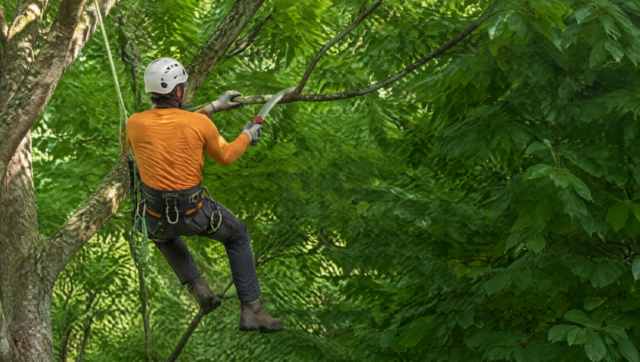
When the cuts are above head height, the branches are too thick for a pruning saw, or an old, overgrown tree needs bringing back down. Gardening Australia's pruning guide says to always seek expert advice for larger trees, and a big mango, fig or olive is best pruned to AS 4373, the Australian Standard for pruning amenity trees. Anything near a power line, including the service line to the house, is never a homeowner job.
Bad cuts have a cost: Gardening Australia says borers tend to attack stressed trees, and poor pruning is one of the stresses it names. In Perth, if you suspect the polyphagous shot-hole borer, the City of Swan says not to prune, remove or dispose of the tree until you've had DPIRD's advice, through the Exotic Plant Pest Hotline.
Does pruning a fruit tree need council approval?
It can. A big old mango or fig is a tree like any other once it reaches the size a council protects, and Darebin, for one, says a fruit tree outside its local law may still be covered by the planning scheme. Before a hard prune or a removal, check with the council, starting from tree removal permits.
Tree pruning: what you can do yourself
You can
- Small branches you can reach from the ground.
- Dead, damaged and crossing branches.
- Keeping a young tree low from its first prune so it stays easy to pick.
Leave to an arborist
- Anything that needs a ladder, and thick limbs.
- Bringing an overgrown tree back down.
- A tree with decay, borer holes or splits.
Hiring an arborist for tree pruning
Do the small cuts yourself each year once the fruit is off, and the tree may never need a big one. If it's already too tall to pick, we'd have an arborist bring it back down properly, once, to the Australian Standard, then keep it at picking height yourself from there.