
Tree removal permits in Hobart
For private trees in Hobart, the rules that usually matter are in the Tasmanian Planning Scheme, which has statewide provisions plus a Local Provisions Schedule for each council. In Hobart that scheme replaced the Hobart Interim Planning Scheme 2015 and the Sullivans Cove Planning Scheme 1997.
A few parts of the scheme do most of the work on trees. The City of Hobart's scheme has a Significant Tree Code, and the council publishes the list and a map; the register applied in the scheme is dated January 2023 and draws on the National Trust of Australia (Tasmania) Significant Tree Register and public nominations. The Local Historic Heritage Code covers heritage places and significant trees, and the Natural Assets Code covers waterway, coastal and priority vegetation areas.
Across the river, City of Clarence lists the things that can restrict removal: heritage places, Natural Assets Code areas, significant trees in its Table C6.5, covenants and Part V agreements. It also has a preliminary assessment form you can send in with a site plan. Kingborough still uses its interim scheme and lists 668 significant trees; see Kingston. The Tasmanian permits page brings it together.
Tree removal in Hobart: what's local
Blue gums and white gums
The Tasmanian blue gum, the state's floral emblem since 1962, grows in tall open forest in the south-east and can reach 70 metres. Knocklofty Reserve protects old-growth white gums. Big eucalypts on suburban blocks are the most common reason for a removal call.
Bush on every side
The City of Hobart manages 4600 hectares of native bushland, with Wellington Park the largest reserve. It closes reserves when the Fire Danger Rating is Extreme or Catastrophic, and planning in bushfire-prone areas has to show the risk can be kept down.
Flash floods off the mountain
Sitting at the foot of kunanyi / Mt Wellington, Hobart can get flash flooding with little warning. After a flood, the council says to stay clear of creeks, drains, fallen trees and fallen power lines.
Your tree is your job
The City of Hobart doesn't inspect or work on private trees. It does expect owners to keep vegetation off footpaths and out of drivers' view, and it can do the work and invoice you if you don't.
TasNetworks for lines
TasNetworks takes reports of trees touching powerlines. Inside your boundary, keeping trees clear of the lines, including the service line to the house, is your responsibility, and only authorised providers can work within 1 metre of its assets.
Storm damage and fallen trees in Hobart
Call 000 if anyone is in danger and the Tasmania SES for storm damage to the home. Stay clear of fallen trees and lines, and call TasNetworks for anything touching the wires. After a bushfire, the City of Hobart warns that trees and branches can fall without warning, so keep people out from under burnt trees until an arborist has looked.
Common tree jobs in Hobart
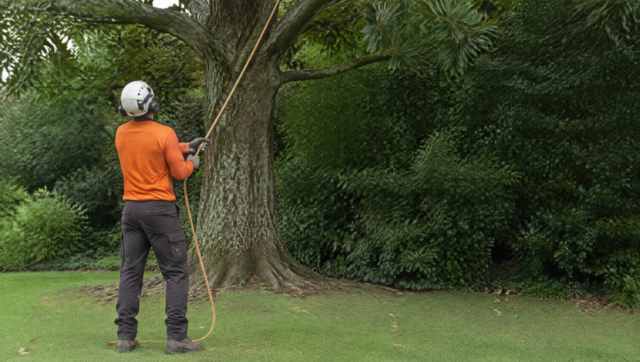
Big gums near the house. A removal on a sloping block usually means taking the tree down in pieces, and the first check is whether it's listed or in a code area.
Branches over the fence. Tasmania has its own neighbour plant law, with a branch removal notice for low overhanging branches. Tree pruning in Hobart explains how it works.
Stumps after removal. Stump grinding in Hobart covers sloping sites, creeks and what's underground.
Footpaths and driveways. Overhanging growth onto public footpaths is the owner's to fix, and a quick prune is usually all it takes. See council street trees for trees on the nature strip.
Hiring an arborist in Hobart
Look your address up on the council's significant tree map, then ask the planning team whether any code applies to the tree, and keep their answer in writing. In Clarence, send in the preliminary assessment form. With that in hand, get an arborist to look at the tree in person and quote for the work and any report the council wants.