
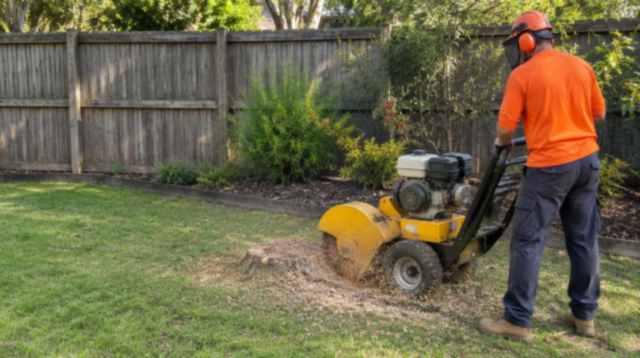
Before stump grinding starts on the Central Coast
Find pipes and cables before the grinder goes in. BYDA plans are indicative only and may not show what's inside your boundary, so BYDA suggests a skilled locator for assets on private property. Safe Work Australia's guide flags a BYDA check once grinding goes deeper than 200mm.
Council rules for stump grinding on the Central Coast
The 10/50 Code's conditions don't stop when the tree hits the ground. To manage erosion and landslip, the RFS says there's to be no disturbance of the soil and vegetation must not be removed below the soil surface.
It also rules out clearing methods that break into the soil, from graders and dozers to excavators. Grinding a stump out below ground is exactly the kind of work to ask about, so check with the RFS or Central Coast Council before a stump from 10/50 clearing is ground.
The RFS adds that landowners keep their duty of care for erosion and landslip even when they follow the Code. On a sloping bush block, that's worth taking seriously.
Stumps from a council-approved removal
If Central Coast Council approved the removal through a Private Tree Works Application, the approval and its conditions are the place to look. If grinding isn't mentioned and you're unsure, ask council before the machine is booked. If the tree came down as an imminent risk, keep the arborist's evidence: council says it must be held for six months and shown on request.
Stump grinding on the Central Coast: what's local
Sand and sandstone
Sydney red gums grow on deep sandy soils and sand over sandstone along this coast, and Brisbane Water National Park is 12,000ha of rugged sandstone. Sand grinds out easily; shallow rock can stop a grinder well short.
Lakes and creeks
The 10/50 Code doesn't allow clearing within 10 metres of a lake or a river at least 2 metres wide. On a lake or creek frontage, a stump question goes to council rather than the RFS rules.
Bush roots
Near bushland, a stump can sit among native trees you're keeping, and their roots run through the same ground. Ask the arborist where the grinding will stop.
Termites in old stumps
A South Australian Museum zoologist told the ABC the termite Coptotermes acinaciformis is typically found in dead stumps and root crowns, commonly eucalypts, and can move up to 50 metres underground. A dead stump near the house is worth dealing with.
Questions to ask about stump grinding on the Central Coast
- How the tree came down: 10/50, a council approval or imminent risk
- The grinding depth, written as a number
- How far the surface roots will be chased
- Who locates services, including private lines inside your boundary
- Where the grindings go
- How bare soil on a slope will be covered afterwards

Hiring an arborist for stump grinding on the Central Coast
We'd work out which rules the tree came down under before anything else. If it was 10/50, we'd leave the stump in place until the RFS or council has answered the grinding question. If it was a council approval, we'd have the grind quoted alongside the removal, with the depth and the clean-up written in.