
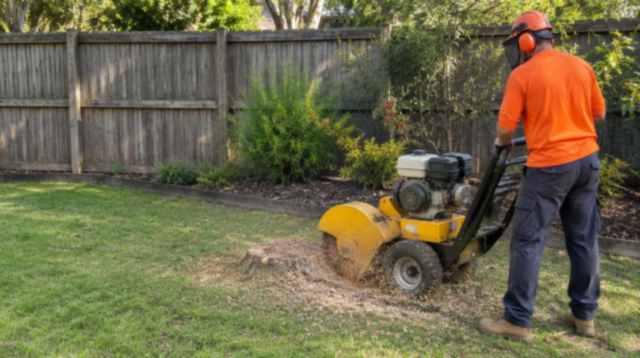
How stump grinding works in Hobart
Hobart is gum country. Blue gums grow naturally in the south-east's tall open forest, and old white gums still stand in reserves like Knocklofty. Some eucalypts regrow after being cut low, sending shoots up from underground storage, so a stump left at ground level can turn back into a thicket of young growth.
Grinding stops that. The machine's cutting wheel takes the stump and surface roots below ground level, leaving a hole of chips and soil. It also removes food for the fungi that colonise old stumps and roots, which Gardening Australia says can feed on a big tree's root system for decades.
Stump grinding in Hobart: what's local
After a storm
Tasmania SES makes dangerous fallen trees safe, then suggests a local tree service for fallen trees that aren't a danger. The stump and root plate left behind are usually where an arborist comes in, once your insurer has seen the damage.
Near creeks and drains
Below kunanyi / Mt Wellington, the city can get flash flooding with little warning, so loose grindings left on a creek bank can end up in the water. Tasmania's Natural Assets Code also covers waterway protection areas, so if the stump is by a creek, ask the council before ground is disturbed.
Code areas and listed trees
If the tree was significant, heritage-listed or in a code area, check any permit conditions before the stump goes. In Clarence, the council's preliminary assessment form is a quick way to ask.
Private trees are private
The City of Hobart doesn't work on trees on private property, so a stump in your yard is yours to sort. Council stumps on the nature strip are a council matter, and it says it informs nearby residents when a street tree is proposed for removal.
Before stump grinding starts in Hobart
Lodge a Before You Dig enquiry at byda.com.au. Safe Work Australia's guide says to check for services around a stump if grinding will go deeper than 200mm, and BYDA's plans don't show private lines inside your boundary, such as power to a shed or irrigation. Grinders throw debris, so keep everyone well back while one runs.
Grind it, or leave it?
| Grind it out | Leave it | |
|---|---|---|
| Regrowth from the stump | Stopped below ground | Can keep shooting |
| Fungi | Less wood left to feed them | Old wood can feed them for years |
| The space | Ready for turf, paving or a new tree | A trip hazard, or a feature to plant around |
| Checks first | BYDA enquiry and any code area | None, unless it's in the way |
Questions to ask about stump grinding in Hobart
- How deep the stump and surface roots will be ground
- Access for the machine: steps, slope, gates and retaining walls
- Who lodges the Before You Dig enquiry
- What happens to the grindings and any root plate
- Whether the site is near a creek or in a code area
- Public liability insurance
Stump grinding in Hobart: what you can do yourself
You can
- Lodge the BYDA enquiry and mark private pipes and cables
- Photograph storm damage for your insurer before anything is moved
- Clear stones, pots and timber from around the stump
- Rub off young shoots from a low stump by hand while you wait
Leave to an arborist
- Running the grinder and setting the exclusion zone
- Root plates lifted out of the ground by wind
- Stumps on steep ground or beside retaining walls
- Stumps near creeks, slabs, fences or pipes

Hiring an arborist for stump grinding in Hobart
If a gum stump is shooting, we'd grind it rather than keep cutting the shoots, because it'll keep trying. If it's beside a creek or the tree was on a protected list, we'd ask the council first. Either way, the BYDA enquiry goes in before the grinder is booked.